BlockManOSJoin the waitlist
BlockManOS plugs into the software Irish property agents already run — agentOS for property and landlord data, QuickBooks Online for financial records, and an AI chat agent that handles inbound maintenance requests on your website. No rekeying. No parallel systems.
Owners and occupants submit maintenance requests through a conversational AI agent on your agency website. The agent verifies the caller is a legitimate owner or occupant, captures the property details and issue description in natural language, and creates a maintenance request record directly in BlockManOS — no static form, no edge cases left unhandled.
The AI agent verifies the caller is a registered owner or occupant for the development before proceeding.
The agent asks follow-up questions, captures the issue description in plain language, and confirms the details before submitting.
A full maintenance request record is created in the platform with development, unit, and issue details populated — ready for your team to action.
BlockManOS is purpose-built for Irish OMCs — already integrating with agentOS and QuickBooks, with an AI chat agent ready to deploy on your website today. Join the waitlist and we'll be in touch.
Questions? Email us at sf-core-org-support-blockmanos@saas-factory.ai
One owner change in either system updates both. Landlord ownership, contact details, and property data travel between BlockManOS and agentOS automatically — so the block management team and the lettings team are always reading the same record.
Bi-directional owner sync When a unit is sold, one update in either platform propagates to both. No double-keying, no stale owner records.
Rental flag on block records Units being managed as rentals in agentOS are clearly flagged on the unit record in BlockManOS — so agents know a letting agent is involved before raising a noise complaint or maintenance issue directly with the owner.
Cross-role contact linking The same individual can be an owner in BlockManOS, a landlord in agentOS, and a contractor — all three roles linked by shared email or mobile, with merged notes visible from any record.
Linked roles at a glance When you open any contact record, their linked roles from both systems appear beneath — one activity overview without switching tabs.
BlockManOS sends new developments as customers and service charge schedules as invoices to QuickBooks Online. Payment status flows back in real time via webhook — so your agents see whether a service charge is outstanding or paid without leaving BlockManOS.
Every unit can carry specific instructions for work orders: contact the letting agent before the owner, use a named preferred contractor, or hold all works above a cost threshold pending owner approval. These preferences are visible to anyone who creates or processes a work order — the right escalation path is followed every time.
Instruct the system to contact a letting agent before the owner — or vice versa — so the right person is looped in first.
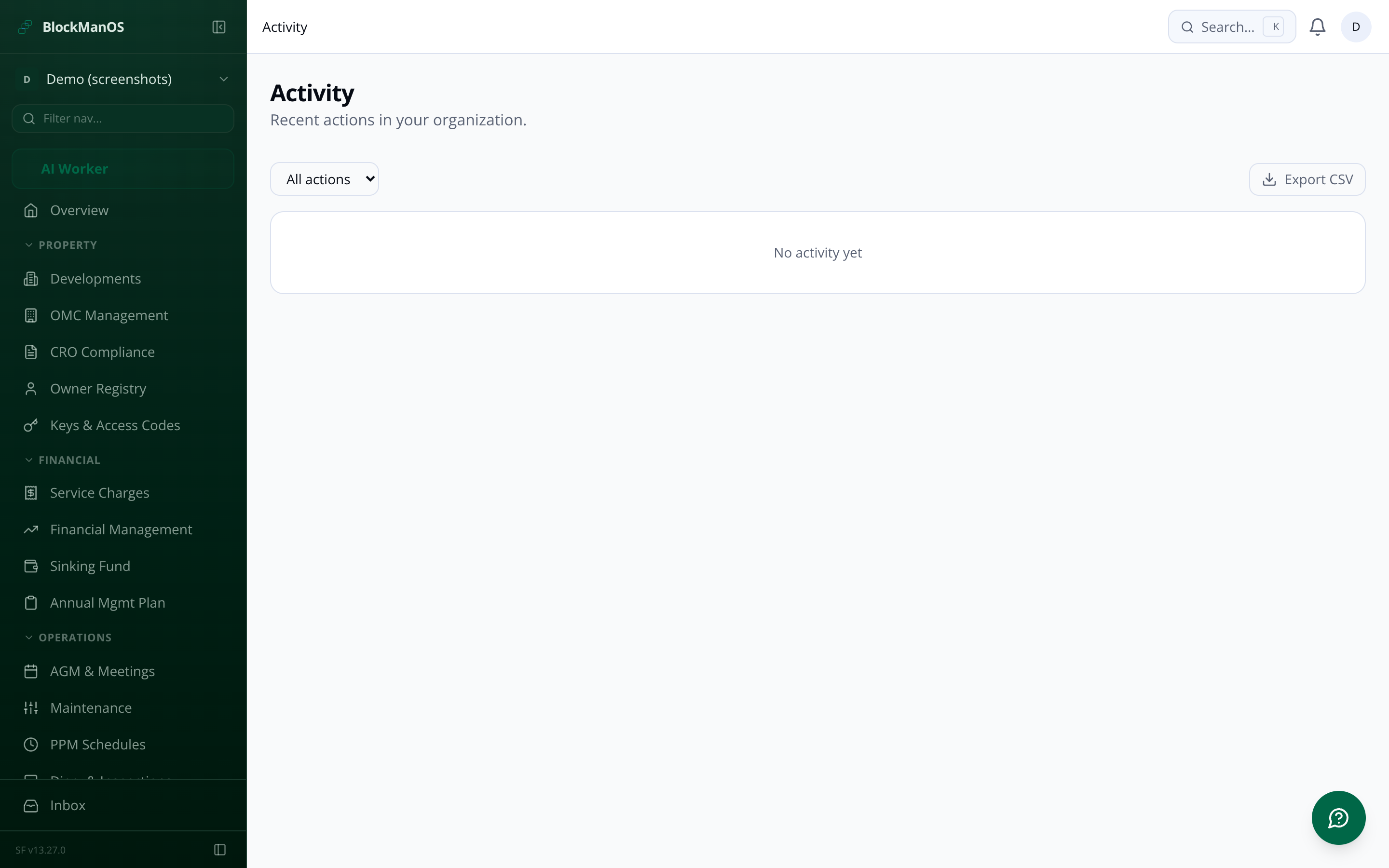
A standalone section for managing keys and gate codes across all developments — with a naming convention (OP-001, OP-002) that prevents duplicates. Codes live here, not buried in property pop-ups. Staff can send a key number and code securely by text message from within the system.
Structured naming convention Keys follow a consistent format (OP-001, OP-002) with duplicate prevention enforced by the system.
Gate and door codes centralised No more codes saved as property pop-up notes — all access codes are stored in a single dedicated section.
Secure SMS dispatch Send a key number and access code to a contractor or owner by text from directly within BlockManOS.
Developments push as QuickBooks customers Each block you manage is created as a customer record in QuickBooks automatically — no manual entry.
Service charge schedules become invoices Annual and instalment demands issued in BlockManOS sync to QuickBooks as invoices, keeping financials in one authoritative ledger.
Real-time payment status via webhook When QuickBooks marks an invoice paid or outstanding, that status surfaces in BlockManOS immediately. Your team sees live payment position without switching systems.
Financials stay in QuickBooks Bank reconciliation, VAT returns, and full accounts remain in QuickBooks. BlockManOS is not a duplicate ledger — it is the operational layer that feeds the accounting layer.
Tag a unit with a specific contractor who must be used for all work on that property — e.g. an owner's nominated tradesperson.
Set a spend limit above which no works proceed without explicit owner sign-off — a clear paper trail for every authorisation.
Portfolio-wide dashboard See all keys across all developments in a single view — useful at a glance when managing multiple sites.